New Rice Festival at Dong Cuong Temple, 2024

Recently, the New Rice Festival of Dong Cuong Temple took place at the National Historical and Cultural Site of Dong Cuong Temple, located in Dong Cuong Commune, Van Yen District, Yen Bai Province. Due to the ongoing priority of recovering from the aftermath of Tropical Storm No. 3, only the ceremonial part of the event was held, with no accompanying festivities.
Traditionally, the rice offering ritual, conducted on the day of the Mao (Cat) in the ninth lunar month each year, is a significant agricultural ceremony deeply embedded in the cultural identity of the Tay Khao people of Van Yen. This ceremony marks the conclusion of a year's labor and production, serving as an expression of gratitude to the heavens, deities, the Mountain Goddess, and ancestors for their blessings of favorable weather and good harvests. It also offers a chance for the local community to gather, exchange agricultural knowledge, and teach younger generations to preserve and promote the rich cultural traditions of the Tay Khao people.
A particularly sacred part of the New Rice Festival is the black buffalo sacrifice to the Mother Goddess and the heavens, performed at midnight on the day of Mao (Cat) in the ninth lunar month, under the ancient jackfruit tree in front of the temple. This ritual holds deep spiritual significance and is uniquely profound. After the buffalo is sacrificed, its meat is used to prepare 36 ceremonial trays, which are then brought into the temple to honor and remember the national heroes and soldiers of various dynasties who sacrificed their lives during the naval battles against the Mongol invaders to protect the homeland.
In addition to the produce and livestock harvested over the year, cốm nếp (young sticky rice) is regarded as the most refined product, embodying the essence of the land and the best of the harvest season. It is offered in gratitude to the Mountain Goddess, the Jade Emperor, and other deities, symbolizing the people's appreciation for the bountiful harvests and their prayers for continued favorable weather, national peace, and prosperity.
Before the New Rice Festival of Dong Cuong Temple in 2024, the National Historical and Cultural Site also hosted a traditional hầu đồng (mediumship ceremony) performance, a spiritual practice deeply rooted in Vietnamese culture.
At the event, within the solemn and serene atmosphere, the thanh đồng (spirit mediums) skillfully embodied various characters in the spirit possession rituals, including revered figures such as the Mother Goddess, Chua Ba, Quan Lon, Chau Ba, Lord Quan Hoang, Tien Co, and Thanh Cau. Their performances, filled with gestures and expressions characteristic of spiritual possession, were complemented by the lively and sacred melodies of chầu văn (Vietnamese ritual singing) music. The lyrics praised the noble virtues, the majestic presence, and the divine merits of the Mother Goddess, while imparting moral lessons about kindness and righteousness. The songs also celebrated the beauty of the mountains, forests, and homeland.
The ritual became even more captivating as the music harmonized with the graceful, dynamic movements of the thanh đồng, dressed in the symbolic green garments of the Mother of the Mountains and Forests. This vibrant display added to the unique and sacred nature of the hầu đồng ceremony at Dong Cuong Temple, making it both deeply spiritual and distinctly enchanting.
The hầu đồng ritual is part of the broader Tín ngưỡng thờ Mẫu Tam phủ (Mother Goddess Worship) tradition of the Vietnamese people in general, and the veneration of the Mother Goddess of the Forests (Mẫu Thượng Ngàn) at Dong Cuong Temple in particular. This sacred practice has been recognized by UNESCO as an Intangible Cultural Heritage of Humanity, signifying its importance and global recognition.
Although the 2024 New Rice Festival at Dong Cuong Temple did not include the festival activities, the event remained distinctive with its series of traditional rituals. These ceremonies play a crucial role in preserving and promoting the unique cultural values associated with the festival, the historical site, and the venerated figures. The customs, strictly observed by the Tay Khao people, included rituals such as welcoming ong Mo (Grand Mo) back to the temple, incense offerings, weekly ceremonies, the black buffalo sacrifice, and the main ritual feast.
Thu Trang

Có thể bạn quan tâm

Tin cùng chuyên mục

Yen Bai Organizes Career Counseling – Enrollment – Employment Fair for Students at Educational Institutions across the Province.

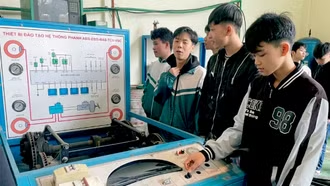
Yen Bai Recruits and Trains 81,504 People in Vocational Education

Since 2021, Yen Bai Province has recruited and provided vocational training for 81,504 people. Of these: 6,359 people (7.8%) received college-level training, 12,710 people (15.6%) received intermediate-level training, and 62,435 people (76.6%) received elementary-level training or training under three months. Each year, the province has supported vocational training for 4,000 to 5,000 rural laborers.
To date, the province has issued 103 planting area codes, covering over 1,165 hectares.

Yen Bai Issues 103 Planting Area Codes

In the first six months of 2025, Yen Bai Province issued two new planting area codes for domestic consumption. To date, the province has granted a total of 103 planting area codes, covering over 1,165 hectares.
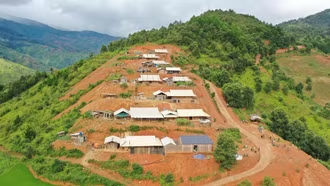
The Hong Nhi Pa Hamlet Resettlement Area, Lao Chai Commune.

Reviving Life After Natural Disasters

After suffering severe losses from flash floods and landslides in recent years, the people of Mu Cang Chai District have seen their lives gradually stabilize thanks to the determined involvement of local Party committees, authorities, and the united support of the wider community. New, spacious houses have risen to replace the ruins left by disasters, opening a new chapter of sustainable recovery in the remote highlands.
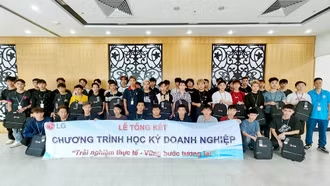
Students of Yen Bai Vocational College participating in the practical experience program of the enterprise semester in Hai Phong City.

Yen Bai: Over 1,200 Workers Connected and Recruited to Work at Enterprises in Hai Phong

Recently, Yen Bai Province has strengthened its cooperation between vocational education institutions and leading enterprises in Hai Phong through the signing of cooperation agreements. In cooperation on employment consulting, job referral, and labor supply with enterprises in Hai Phong City, Yen Bai Province has connected and recruited over 1,200 workers to work at businesses based in Hai Phong.
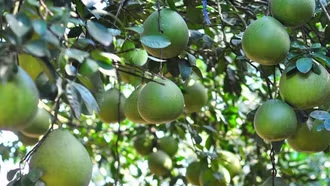
The mulberry cultivation and silkworm rearing model is generating income for farmers in Tran Yen District.

Tran Yen Aims to Expand Mulberry Cultivation to 1,200 Hectares by the End of 2025

Identifying mulberry cultivation and silkworm rearing as key sectors in agricultural development, Tran Yen District has recently focused on actively transforming its mulberry and silkworm production areas to enhance product value. Despite significant damage caused by Storm No. 3 in 2024, Tran Yen has set out multiple solutions to achieve its goal of cultivating 1,200 hectares of mulberry by the end of 2025.
With a range of comprehensive solutions, Yen Bai is enhancing its appeal to attract investors in the tourism sector.

Yen Bai Approves 26 Tourism Projects for Investment

In an effort to effectively develop tourism based on its natural and cultural resources, Yen Bai Province has recently focused on promoting and selectively showcasing its potential and strengths. The province has placed particular emphasis on infrastructure investment, especially in key tourism areas, to attract and invite investors.
People of Yen Bai actively participate in physical exercise and sports to improve their health.

Yen Bai: 45.5% of the Population Regularly Engages in Physical Exercise and Sports

In recent years, the movement of physical training and sports in Yen Bai Province has seen vibrant and rapid development, spreading widely throughout the local communities. Mass sports have flourished, and the number of people regularly participating in physical exercise and sports has steadily increased. Ethnic sports and traditional folk games continue to be preserved and promoted.
Local residents actively participate in cultural and artistic activities, enriching their spiritual life.

Yen Bai: Proportion of “Cultural Families” Increases by 9.1% Compared to the Beginning of the Term

In recent years, Yen Bai has made significant and comprehensive progress in building local culture and promoting human development, contributing effectively to the province’s sustainable growth. These achievements have also enhanced the efficiency of State management in the field of culture amid the challenges of a market-oriented economy and international integration.
Tourists experience rice harvesting with local residents in Vu Linh Commune, Yen Binh District.

Combining Culture and Nature in Tourism Development

Blessed with pristine natural landscapes and a rich repository of ethnic cultural heritage, Yen Binh District in recent years has been gradually harmonizing conservation and development by building three pillars of tourism: placing people at the center, nature as the foundation, and culture as the identity — all aimed at sustainable growth.
Tourism establishments across the province are enhancing green, clean, and beautiful landscapes to attract summer visitors.

Yen Bai Ready for a Vibrant Tourism Season

Summer is a peak time for travel, entertainment, and recreation. To meet increasing visitor demand, Yen Bai Province has, from the beginning of each year, implemented various tourism promotion measures, strengthened state management in the sector, and encouraged businesses and individuals to develop tourism products and enhance technical infrastructure — all with the aim of attracting more tourists than in previous years.
More spacious and modern houses are appearing in the highlands of Yen Bai.

No More “Blank Spots” in New Rural Development – A New Look for Mountainous Areas

There are no longer any "blank districts" in new rural development (NRD) — a remarkable achievement recently attained by Yen Bai Province, marking a significant milestone in the journey toward building prosperous and happy rural areas. The dramatic transformation of localities, particularly highland districts once faced with immense hardships, has affirmed the province’s correct direction and the spirit of unity and collective effort shared by the Party, government, and all ethnic communities in the province.
fb yt zl tw