The Unique Bamboo Dance of the Thai People in Muong Lo

The bamboo dance, a cultural hallmark of the ethnic groups in Vietnam’s Northwest region, holds a special place in the traditions of the Thai people in Muong Lo, Nghia Lo (Yen Bai). Characterized by graceful movements, the resonant sound of bamboo poles clashing, and the harmonious blend of music and choreography, this dance serves not only as an art form but also as a bridge fostering community connection.
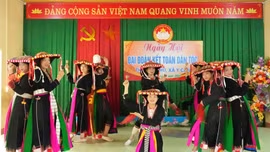
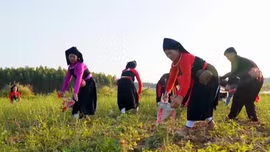
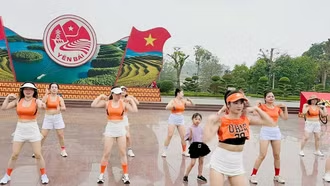
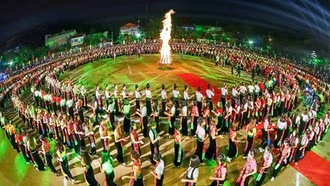
In recent days, the Golden Field Square, the heart of the Muong Lo plains in Nghia Lo, has been ablaze with vibrant colors, hosting 16 bamboo dance teams composed of 480 performers from 14 communes and wards. Artisans, teachers, and students alike come together to celebrate this traditional dance, deeply rooted in the cultural identity of the Thai people in Muong Lo and other ethnic groups in the Northwest. The rhythmic sounds of bamboo poles colliding, combined with music and dance, create an incredibly lively and captivating atmosphere.
The performers’ fluid yet decisive movements, paired with traditional attire, offer the audience a truly spectacular cultural feast. The electrifying energy of the performance has not only captivated local residents but also attracted tourists. Many spectators, even those unfamiliar with the bamboo dance, have eagerly joined in, adding to the joyous spirit of the event.
Artisan Dieu Thi Xien from Nghia An Commune, Nghia Lo Town, remarked: "The bamboo dance is one of the most distinctive cultural features, embodying the identity of the Thai ethnic group. Beyond being a communal activity, it symbolizes solidarity, dexterity, and the joy found in labor and daily life. For this reason, Nghia Lo Town has always preserved and promoted this cultural beauty, making it a source of pride for the western gateway of Yen Bai Province.”
According to Ms. Xien, the bamboo dance is a unique cultural expression that has become a familiar performance in Muong Lo’s festivals. Alongside the xoe dance, the bamboo dance profoundly reflects the cultural identity, emotions, and spirit of the Thai people in Vietnam’s Northwest.
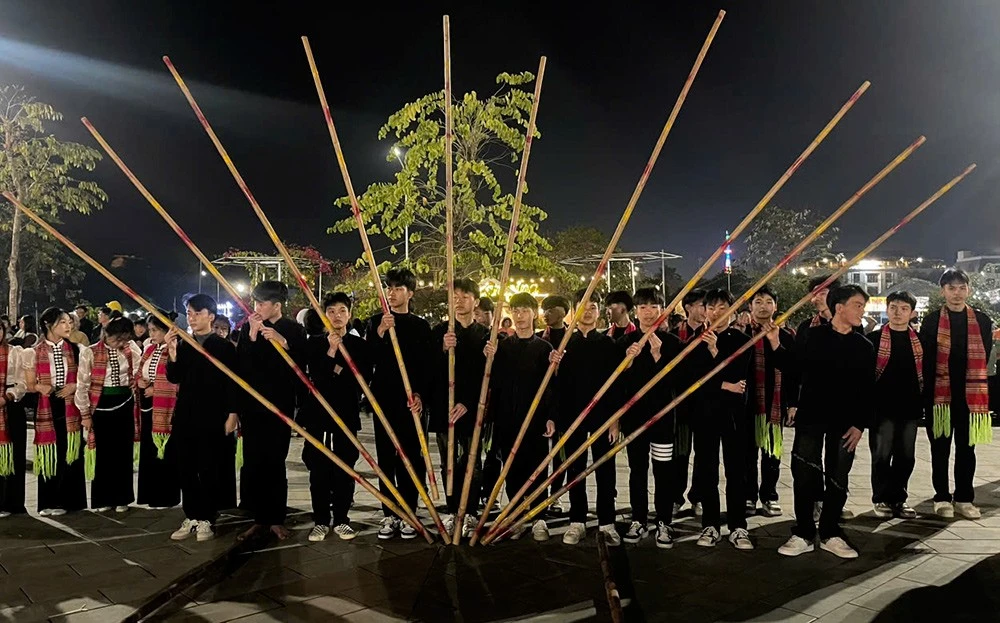
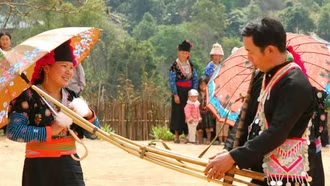
Preparing bamboo poles for the dance.
Creating a flawless bamboo dance performance requires meticulous preparation of the props. The process begins with the selection of two large, straight bamboo poles to serve as the primary frame. Then, smaller bamboo or rattan poles, of appropriate length and diameter, are arranged parallel to one another, forming a long row. The spacing between the poles is carefully adjusted to allow for the dancers’ agile movements, ensuring the dance flows smoothly and beautifully.
The bamboo dance team is typically divided into two groups. The first group, responsible for clapping the bamboo poles, creates rhythmic sounds by evenly striking the smaller poles. The second group, the dancers, performs graceful movements synchronized with the clapping sounds. To excel at the bamboo dance, participants must skillfully coordinate their hands and feet, avoiding contact with the bamboo poles. Artisan Dieu Thi Xien explained in detail: "Initially, the pace of the clapping is slow to allow the dancers to familiarize themselves. Gradually, the speed increases, introducing new challenges. A harmonious combination between the clappers and the dancers results in an impressive performance, bringing joy to the audience.”
Luong Manh Ha, Vice Chairman of Nghia Lo Town People's Committee, emphasized: "We firmly believe that the bamboo dance, as a communal activity, serves as a vivid and authentic representation of the culture of Muong Lo's ethnic communities, particularly the Thai people. Through our efforts in preservation and development, the bamboo dance will feature more prominently in major local programs and festivals. Visitors will have the opportunity to enjoy lively and unique performances, immersing themselves in the dance while gaining a deeper understanding of Nghia Lo's land and people.”
With its distinctive charm, the bamboo dance, alongside the Thai xoe dance—recognized as an Intangible Cultural Heritage of Humanity—adds another layer of cultural richness to the Thai community in Muong Lo, Nghia Lo. Increasingly admired for its vibrant and captivating essence, the bamboo dance continues to enchant audiences far and wide.
Hoai Van

Có thể bạn quan tâm

Tin cùng chuyên mục

Yen Bai Organizes Career Counseling – Enrollment – Employment Fair for Students at Educational Institutions across the Province.

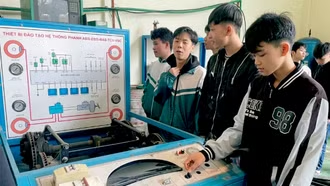
Yen Bai Recruits and Trains 81,504 People in Vocational Education

Since 2021, Yen Bai Province has recruited and provided vocational training for 81,504 people. Of these: 6,359 people (7.8%) received college-level training, 12,710 people (15.6%) received intermediate-level training, and 62,435 people (76.6%) received elementary-level training or training under three months. Each year, the province has supported vocational training for 4,000 to 5,000 rural laborers.
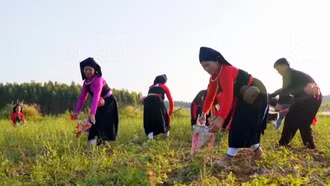
To date, the province has issued 103 planting area codes, covering over 1,165 hectares.

Yen Bai Issues 103 Planting Area Codes

In the first six months of 2025, Yen Bai Province issued two new planting area codes for domestic consumption. To date, the province has granted a total of 103 planting area codes, covering over 1,165 hectares.
The Hong Nhi Pa Hamlet Resettlement Area, Lao Chai Commune.

Reviving Life After Natural Disasters

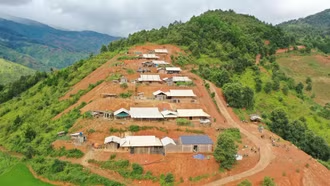
After suffering severe losses from flash floods and landslides in recent years, the people of Mu Cang Chai District have seen their lives gradually stabilize thanks to the determined involvement of local Party committees, authorities, and the united support of the wider community. New, spacious houses have risen to replace the ruins left by disasters, opening a new chapter of sustainable recovery in the remote highlands.
Students of Yen Bai Vocational College participating in the practical experience program of the enterprise semester in Hai Phong City.

Yen Bai: Over 1,200 Workers Connected and Recruited to Work at Enterprises in Hai Phong

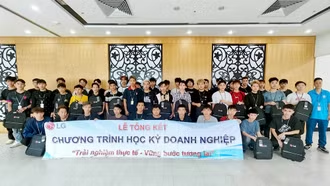
Recently, Yen Bai Province has strengthened its cooperation between vocational education institutions and leading enterprises in Hai Phong through the signing of cooperation agreements. In cooperation on employment consulting, job referral, and labor supply with enterprises in Hai Phong City, Yen Bai Province has connected and recruited over 1,200 workers to work at businesses based in Hai Phong.
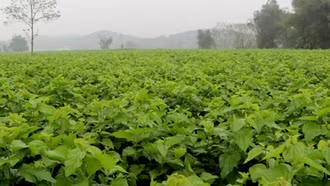
The mulberry cultivation and silkworm rearing model is generating income for farmers in Tran Yen District.

Tran Yen Aims to Expand Mulberry Cultivation to 1,200 Hectares by the End of 2025

Identifying mulberry cultivation and silkworm rearing as key sectors in agricultural development, Tran Yen District has recently focused on actively transforming its mulberry and silkworm production areas to enhance product value. Despite significant damage caused by Storm No. 3 in 2024, Tran Yen has set out multiple solutions to achieve its goal of cultivating 1,200 hectares of mulberry by the end of 2025.
With a range of comprehensive solutions, Yen Bai is enhancing its appeal to attract investors in the tourism sector.

Yen Bai Approves 26 Tourism Projects for Investment

In an effort to effectively develop tourism based on its natural and cultural resources, Yen Bai Province has recently focused on promoting and selectively showcasing its potential and strengths. The province has placed particular emphasis on infrastructure investment, especially in key tourism areas, to attract and invite investors.
People of Yen Bai actively participate in physical exercise and sports to improve their health.

Yen Bai: 45.5% of the Population Regularly Engages in Physical Exercise and Sports

In recent years, the movement of physical training and sports in Yen Bai Province has seen vibrant and rapid development, spreading widely throughout the local communities. Mass sports have flourished, and the number of people regularly participating in physical exercise and sports has steadily increased. Ethnic sports and traditional folk games continue to be preserved and promoted.
Local residents actively participate in cultural and artistic activities, enriching their spiritual life.

Yen Bai: Proportion of “Cultural Families” Increases by 9.1% Compared to the Beginning of the Term

In recent years, Yen Bai has made significant and comprehensive progress in building local culture and promoting human development, contributing effectively to the province’s sustainable growth. These achievements have also enhanced the efficiency of State management in the field of culture amid the challenges of a market-oriented economy and international integration.
Tourists experience rice harvesting with local residents in Vu Linh Commune, Yen Binh District.

Combining Culture and Nature in Tourism Development

Blessed with pristine natural landscapes and a rich repository of ethnic cultural heritage, Yen Binh District in recent years has been gradually harmonizing conservation and development by building three pillars of tourism: placing people at the center, nature as the foundation, and culture as the identity — all aimed at sustainable growth.
Tourism establishments across the province are enhancing green, clean, and beautiful landscapes to attract summer visitors.

Yen Bai Ready for a Vibrant Tourism Season

Summer is a peak time for travel, entertainment, and recreation. To meet increasing visitor demand, Yen Bai Province has, from the beginning of each year, implemented various tourism promotion measures, strengthened state management in the sector, and encouraged businesses and individuals to develop tourism products and enhance technical infrastructure — all with the aim of attracting more tourists than in previous years.
More spacious and modern houses are appearing in the highlands of Yen Bai.

No More “Blank Spots” in New Rural Development – A New Look for Mountainous Areas

There are no longer any "blank districts" in new rural development (NRD) — a remarkable achievement recently attained by Yen Bai Province, marking a significant milestone in the journey toward building prosperous and happy rural areas. The dramatic transformation of localities, particularly highland districts once faced with immense hardships, has affirmed the province’s correct direction and the spirit of unity and collective effort shared by the Party, government, and all ethnic communities in the province.
fb yt zl tw