Van Yen Develops Tourism in Connection with Medicinal Herb Regions: A New Direction with Unique Identity

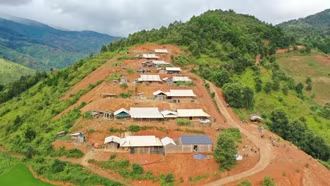
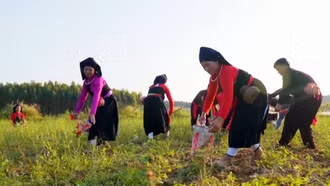
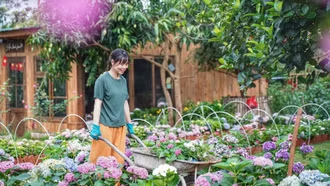
With diverse terrain, a temperate climate, and rich soil, Van Yen district has favorable conditions for agricultural development, particularly in cultivating valuable medicinal herbs. In addition to experiential tourism, spiritual tourism, and community-based tourism, Van Yen has been focusing on developing agricultural tourism linked to the utilization of its medicinal herb regions.
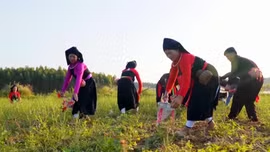
Located within the Na Hau Nature Reserve, Na Hau commune is home to 30 rare medicinal plant species, including amomum, fleeceflower root, honeysuckle,
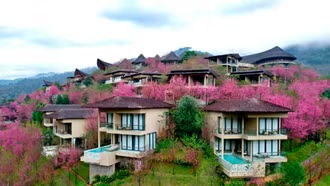
cardamom, tree fern, Polyscias fruticosa, and passionflower. To leverage its potential for agricultural tourism combined with medicinal herb exploitation, the commune has intensified promotional efforts through mass media and digital platforms, attracted investment, and encouraged social engagement in tourism development and major festivals. Additionally, local households are supported in developing homestay tourism models.
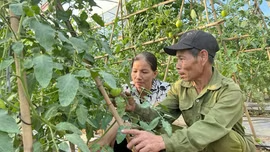
Ly Ton Cau, Chairman of the People's Committee of Na Hau Commune, stated: "Currently, Na Hau has developed five community-based homestay tourism models. These models focus on leveraging local agricultural products to enhance visitor experiences, including accommodation, sightseeing, and hands-on activities. In 2024, the commune welcomed nearly 8,000 visitors, generating revenue exceeding VND 10 billion." Van Yen district boasts significant potential with its medicinal herb regions, including the Na Hau Nature Reserve, the thorny gourd area in Dong An commune, and the Gynostemma pentaphyllum cultivation in Tan Hop commune.
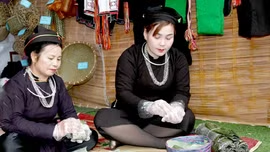
Most notably, cinnamon is widely grown across multiple localities. Furthermore, ethnic communities in the district have preserved extensive knowledge of medicinal plants, along with their processing and application methods. 
The medicinal herb regions are also enriched with mountains, rivers, waterfalls, and other natural landscapes, making them attractive destinations for tourists. In recent years, Van Yen has taken its initial steps in developing agricultural tourism linked to medicinal herbs. Some tourism products have emerged, including guided
tours of medicinal herb gardens, experiences in herb processing, herbal baths, and cuisine featuring medicinal ingredients.
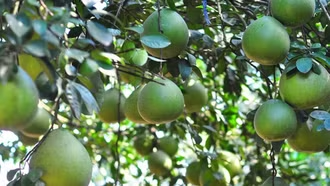
Besides, the district is focusing on developing OCOP (One Commune One Product) products, with many medicinal herb-related OCOP products being developed and promoted. These efforts contribute to increasing the value of local products and improving residents' incomes. Some notable examples include CND instant drinkable thorny gourd extract gel from the Yen Bai Agricultural Production Services Cooperative in Dai Phac commune, pure cinnamon essential oil from Thac Tien General Services Cooperative in Mo Vang commune, off-season tomatoes from Trung Thanh Organic Agricultural Services Cooperative in Yen Hop commune, cinnamon essential oil from Lam Phuong Linh Cooperative in Dai Phac commune, Lam Giang green-skinned pomelo from the Pomelo Cultivation Cooperative in Lam Giang commune, and various herbal essential oils such as Dai Phu An cinnamon oil and lemongrass essential oil from Dai Phu An Traditional Medicine joint Stock Company. Additionally, several businesses have invested in medicinal herb tourism, contributing to improving service quality,
including Dai Phu An Traditional Medicine joint Stock Company and Yen Bai Agricultural Production Services Cooperative.
Le Thanh Hung, Vice Chairman of the People's Committee of Van Yen district, stated: "In 2025, the district will focus on developing herbal bath services at the hot springs in Cao Son, Ban Lung, and Lang Than villages of Phong Du Thuong commune, as well as in Vien Son and Dai Son communes, where a variety of
valuable medicinal plants grow. Additionally, we will organize cultural festivals associated with medicinal herbs, develop agricultural tourism combined with ecotourism and community-based tourism, invest in upgrading tourism infrastructure, train high-quality human resources, and implement service standards as required. We also plan to establish more distinctive tourism brands, host promotional events, utilize modern media channels to boost tourism marketing, support medicinal herb producers in enhancing product quality and branding, and facilitate connections between local producers and tourism enterprises to promote their products."
The development of agricultural tourism linked to medicinal herb exploitation has created a new path for the economic and social growth of Van Yen. In 2024, the
district welcomed 235,000 overnight visitors, generating revenue of VND 255 billion, achieving 150% of its target. To further expand this type of tourism, Van
Yen will continue to intensify tourism promotion efforts across various media platforms and digital channels to reach a broader audience. Additionally, the district will continue to invest in comprehensive tourism infrastructure, attract resources for agricultural tourism development, and contribute to the sustainable and rapid socio-economic development of the region.
Visitors to Van Yen can experience and explore medicinal herb regions, including the Gynostemma pentaphyllum fields in Tan Hop commune and the Na Hau
Nature Reserve. They can also enjoy herbal baths at the Ecotourism - Community Tourism site in Khe Cam village, Ngoi A commune, as well as at the Dai Phu An
Health Resort and Spa in Mau A town.
Thanh Tan
Có thể bạn quan tâm

Tin cùng chuyên mục

Yen Bai Organizes Career Counseling – Enrollment – Employment Fair for Students at Educational Institutions across the Province.

Yen Bai Recruits and Trains 81,504 People in Vocational Education

Since 2021, Yen Bai Province has recruited and provided vocational training for 81,504 people. Of these: 6,359 people (7.8%) received college-level training, 12,710 people (15.6%) received intermediate-level training, and 62,435 people (76.6%) received elementary-level training or training under three months. Each year, the province has supported vocational training for 4,000 to 5,000 rural laborers.
To date, the province has issued 103 planting area codes, covering over 1,165 hectares.

Yen Bai Issues 103 Planting Area Codes

In the first six months of 2025, Yen Bai Province issued two new planting area codes for domestic consumption. To date, the province has granted a total of 103 planting area codes, covering over 1,165 hectares.
The Hong Nhi Pa Hamlet Resettlement Area, Lao Chai Commune.

Reviving Life After Natural Disasters

After suffering severe losses from flash floods and landslides in recent years, the people of Mu Cang Chai District have seen their lives gradually stabilize thanks to the determined involvement of local Party committees, authorities, and the united support of the wider community. New, spacious houses have risen to replace the ruins left by disasters, opening a new chapter of sustainable recovery in the remote highlands.
Students of Yen Bai Vocational College participating in the practical experience program of the enterprise semester in Hai Phong City.

Yen Bai: Over 1,200 Workers Connected and Recruited to Work at Enterprises in Hai Phong

Recently, Yen Bai Province has strengthened its cooperation between vocational education institutions and leading enterprises in Hai Phong through the signing of cooperation agreements. In cooperation on employment consulting, job referral, and labor supply with enterprises in Hai Phong City, Yen Bai Province has connected and recruited over 1,200 workers to work at businesses based in Hai Phong.
The mulberry cultivation and silkworm rearing model is generating income for farmers in Tran Yen District.

Tran Yen Aims to Expand Mulberry Cultivation to 1,200 Hectares by the End of 2025

Identifying mulberry cultivation and silkworm rearing as key sectors in agricultural development, Tran Yen District has recently focused on actively transforming its mulberry and silkworm production areas to enhance product value. Despite significant damage caused by Storm No. 3 in 2024, Tran Yen has set out multiple solutions to achieve its goal of cultivating 1,200 hectares of mulberry by the end of 2025.
With a range of comprehensive solutions, Yen Bai is enhancing its appeal to attract investors in the tourism sector.

Yen Bai Approves 26 Tourism Projects for Investment

In an effort to effectively develop tourism based on its natural and cultural resources, Yen Bai Province has recently focused on promoting and selectively showcasing its potential and strengths. The province has placed particular emphasis on infrastructure investment, especially in key tourism areas, to attract and invite investors.
People of Yen Bai actively participate in physical exercise and sports to improve their health.

Yen Bai: 45.5% of the Population Regularly Engages in Physical Exercise and Sports

In recent years, the movement of physical training and sports in Yen Bai Province has seen vibrant and rapid development, spreading widely throughout the local communities. Mass sports have flourished, and the number of people regularly participating in physical exercise and sports has steadily increased. Ethnic sports and traditional folk games continue to be preserved and promoted.
Local residents actively participate in cultural and artistic activities, enriching their spiritual life.

Yen Bai: Proportion of “Cultural Families” Increases by 9.1% Compared to the Beginning of the Term

In recent years, Yen Bai has made significant and comprehensive progress in building local culture and promoting human development, contributing effectively to the province’s sustainable growth. These achievements have also enhanced the efficiency of State management in the field of culture amid the challenges of a market-oriented economy and international integration.
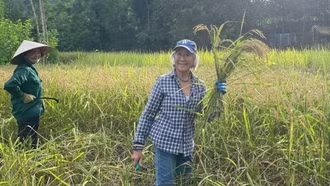
Tourists experience rice harvesting with local residents in Vu Linh Commune, Yen Binh District.

Combining Culture and Nature in Tourism Development

Blessed with pristine natural landscapes and a rich repository of ethnic cultural heritage, Yen Binh District in recent years has been gradually harmonizing conservation and development by building three pillars of tourism: placing people at the center, nature as the foundation, and culture as the identity — all aimed at sustainable growth.
Tourism establishments across the province are enhancing green, clean, and beautiful landscapes to attract summer visitors.

Yen Bai Ready for a Vibrant Tourism Season

Summer is a peak time for travel, entertainment, and recreation. To meet increasing visitor demand, Yen Bai Province has, from the beginning of each year, implemented various tourism promotion measures, strengthened state management in the sector, and encouraged businesses and individuals to develop tourism products and enhance technical infrastructure — all with the aim of attracting more tourists than in previous years.
More spacious and modern houses are appearing in the highlands of Yen Bai.

No More “Blank Spots” in New Rural Development – A New Look for Mountainous Areas

There are no longer any "blank districts" in new rural development (NRD) — a remarkable achievement recently attained by Yen Bai Province, marking a significant milestone in the journey toward building prosperous and happy rural areas. The dramatic transformation of localities, particularly highland districts once faced with immense hardships, has affirmed the province’s correct direction and the spirit of unity and collective effort shared by the Party, government, and all ethnic communities in the province.
fb yt zl tw